This is Alanna's BOB for the unit on probability.
This is unit is understandable. I had expected it to be quite challenging, with experiences from the past. I have always had trouble with this unit. I do know the stuff. But getting started is what I have the most trouble with. Once I get started I know what I'm doing. At first I understood it very clear. I was positive on what I was doing...but I don't mean to sound rude but Mr. K you tend to explain too much that it gets over my head.. I start to overthink then BAM I can't grasp it anymore. Sometimes I'm able to get back on track. Another problem I have is trying to figure out what the question is asking.
I detest this unit.
Showing posts with label alanna. Show all posts
Showing posts with label alanna. Show all posts
Tuesday, January 15, 2008


Thursday, October 25, 2007
Identities
Whats up everyone! Im scribe for todays class. ALANNA!
I know its a crappy picture but you can see it in todays slides none the less you should be able to recognize it.
1. Given sinA= 4/5 cosB=-5/13. With cosA<0>0. Find cos(A + B)
-The best start off for this question is to draw a diagram which we have done, just so it makes it easier to determine the equation that we will be using later on.
-Now, since we are trying to find cos(A + B) we will write the rest of the equation that goes along with it.
Recall:

Its the sine dance! The equation that goes along with cos(A +B) is written as: cos(A + B)= cosAcosB - sinAsinB
-Then we plug in the specified #'s from the diagrams we drew. So cosA is (-3/5) because in the alpha diagram the cosA is adjacent over hypotenuse. just keep plugging in the numbers for the rest of the equation.
-Once your done writing out the rest of the equation work them out by getting the common denominator. You should end up with the answer -33/65. Which results with the answer being in Quad. III.
Now its nearing the end of class and he quickly introduced Proofs of the Sum and Difference Identities.

If we rotate diagram 1 so that R equals 90 degress and P is on the axis it will look like diagram 2. pretty much everything shifts clockwise.
Q'P' = QP
Now what we have to do is find the distance from Q'P' by using the distance formula:
= √((cos A- B) - 1)² + ((sin A - B) - 0)²
= √(cosA - cosB)² + (sinA - sinB)²
Around here Mr.K was totally rushing everything haha. Trying to finish the question before the bell rang. I didn't really understand a word he said after this plus I could no longer see the smart board cuz he was so busy writing.
Besides the end of the class it was pretty ok math that we learned today. Very understandable. Hope you got something out of my blog.
Drum roll please. "Attention! The next scribe is..........Derek!" ( I picked it randomly!)
Well todays class, in my opinion went very quick yet it was compact because we were introduced a new topic in math today called Proofs of the Sum and Difference Identities.
First we started off the class with the usual identities problems. Nothing new there because it was all straight forward unless if you havent been doing your homework.
OK now onto math!
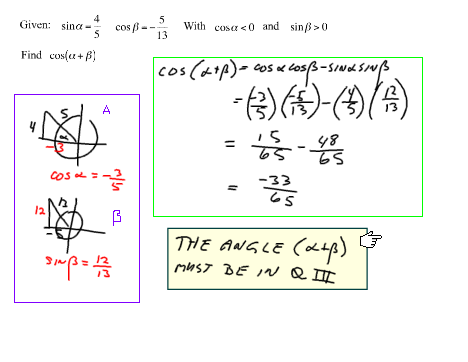
I know its a crappy picture but you can see it in todays slides none the less you should be able to recognize it.
1. Given sinA= 4/5 cosB=-5/13. With cosA<0>0. Find cos(A + B)
-The best start off for this question is to draw a diagram which we have done, just so it makes it easier to determine the equation that we will be using later on.
-Now, since we are trying to find cos(A + B) we will write the rest of the equation that goes along with it.
Recall:
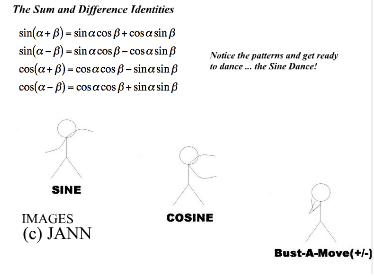
Its the sine dance! The equation that goes along with cos(A +B) is written as: cos(A + B)= cosAcosB - sinAsinB
-Then we plug in the specified #'s from the diagrams we drew. So cosA is (-3/5) because in the alpha diagram the cosA is adjacent over hypotenuse. just keep plugging in the numbers for the rest of the equation.
-Once your done writing out the rest of the equation work them out by getting the common denominator. You should end up with the answer -33/65. Which results with the answer being in Quad. III.
Now its nearing the end of class and he quickly introduced Proofs of the Sum and Difference Identities.
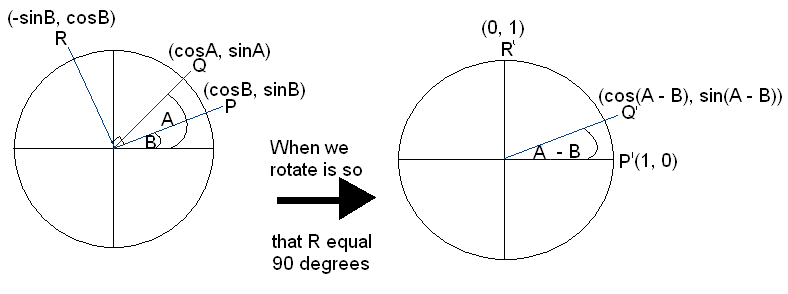
If we rotate diagram 1 so that R equals 90 degress and P is on the axis it will look like diagram 2. pretty much everything shifts clockwise.
Q'P' = QP
Now what we have to do is find the distance from Q'P' by using the distance formula:
= √((cos A- B) - 1)² + ((sin A - B) - 0)²
= √(cosA - cosB)² + (sinA - sinB)²
Around here Mr.K was totally rushing everything haha. Trying to finish the question before the bell rang. I didn't really understand a word he said after this plus I could no longer see the smart board cuz he was so busy writing.
Besides the end of the class it was pretty ok math that we learned today. Very understandable. Hope you got something out of my blog.
Drum roll please. "Attention! The next scribe is..........Derek!" ( I picked it randomly!)
Monday, October 1, 2007
Transformations
Hello everybody this is Alanna with the scribe post for today.
A.M Class:
This morning Mr. K gave us some time to work on a few questions to start off the period.


For part A the last two questions are the ones the I'll be concentrating on because those are the ones that the class somewhat had trouble on.
The coordinates of point, A, on the graph y= f(x) are (-2, -3). What are the coordinates of its image on each of the following graphs?
1. y= 3f(x)
First off we were given the points for A in the beginning of the question: (-2, -3). Since the 3 is outside of the brackets this will cause Only the output to be tripled. So the x values with remain the same.
(-3)(3)= -9
Leaving us with the coordinates of (-2, -9)
2. y= f(1/2x)
We take the x value of coordinate A, which is (-2) and multiply it by the reciprocal in the equation which is (2/1) or just the number 2.
(-2)(2)= 4
Leaving us with the coordinates of (-4, -3)
*note- Mr.K told us that since we are in a higher class of math we don't divide anymore, we multiply everything.
For part B of the questions we were given the same thing but except this time we have to work backwards.
e.x We are given coordinates (5, -4) and equation y= f(x - 4)-5, now we have to find the original coordinates of B.
Take the x coordinate 5 and add -4, which will give you 1. For the y coordinate take -4 and subtract -5 and it will give you 1. This will give you the coordinates (1, 1).
After doing these questions he gave one more long question and I'm pretty sure everyone will agree that the last part of the question was complicated.
Not until one of the students pointed out an easier way to solve the question and pretty much everybody liked his way better. Not sure of the guys name but good job!
The questions are on slide 2 of todays lesson and "that guys" method is on slide 3. What he did was just fill in the green equation on slide 2 then just worked on it from there by isolating the x variable. That gives you the original coordinates of B that was asked for.
P.M Class
To begin the afternoon class Mr. K rambled on about the calculator and how they can have technical limitations.
After that we applied our knowledge of transformations onto graph. Thank fully we had that excerise because it made things even more clearer.
Later on we learned about odd and even functions.
Even Functions:
To tell if its an even function what you get is kinda like a mirror image on the Y axis.

Even Only IF f(-x) = (x)
f(x)= x^2
f(-x)= (-x)^2
f(-x) = x^2
This is equal because the end result is the same thing as the beginning equation.
g(x)= x^2 + 2x
g(-x)= (-x)^2 + 2(-x)
g(-x)= x^2 - 2x
Not equal because in the end you end up with x^2 - 2x which is not the same as the original.
Odd Functions:
To tell if its an odd function by a glance is if you are able to get the same image if you flipped it over.
e.x

A function is odd only IF f(-x) = -f(x)
f(x) = x^3 - x
f(-x) = (-x)^3 - (-x)
f(x) = -x^3 + x
not even
-f(x) = -(x^3 - x)
-f(x) = -x^3 + x
since f(-x) = -f(x) this is an odd function.
The bell rang for class change so that was the end of the class. Mr. K assigned exercise 9 today.
Tomorrows scribe will be Mary Ann.


A.M Class:
This morning Mr. K gave us some time to work on a few questions to start off the period.

For part A the last two questions are the ones the I'll be concentrating on because those are the ones that the class somewhat had trouble on.
The coordinates of point, A, on the graph y= f(x) are (-2, -3). What are the coordinates of its image on each of the following graphs?
1. y= 3f(x)
First off we were given the points for A in the beginning of the question: (-2, -3). Since the 3 is outside of the brackets this will cause Only the output to be tripled. So the x values with remain the same.
(-3)(3)= -9
Leaving us with the coordinates of (-2, -9)
2. y= f(1/2x)
We take the x value of coordinate A, which is (-2) and multiply it by the reciprocal in the equation which is (2/1) or just the number 2.
(-2)(2)= 4
Leaving us with the coordinates of (-4, -3)
*note- Mr.K told us that since we are in a higher class of math we don't divide anymore, we multiply everything.
For part B of the questions we were given the same thing but except this time we have to work backwards.
e.x We are given coordinates (5, -4) and equation y= f(x - 4)-5, now we have to find the original coordinates of B.
Take the x coordinate 5 and add -4, which will give you 1. For the y coordinate take -4 and subtract -5 and it will give you 1. This will give you the coordinates (1, 1).
After doing these questions he gave one more long question and I'm pretty sure everyone will agree that the last part of the question was complicated.
Not until one of the students pointed out an easier way to solve the question and pretty much everybody liked his way better. Not sure of the guys name but good job!
The questions are on slide 2 of todays lesson and "that guys" method is on slide 3. What he did was just fill in the green equation on slide 2 then just worked on it from there by isolating the x variable. That gives you the original coordinates of B that was asked for.
P.M Class
To begin the afternoon class Mr. K
rambled on about the calculator and how they can have technical limitations.After that we applied our knowledge of transformations onto graph. Thank fully we had that excerise because it made things even more clearer.
Later on we learned about odd and even functions.
Even Functions:
To tell if its an even function what you get is kinda like a mirror image on the Y axis.

Even Only IF f(-x) = (x)
f(x)= x^2
f(-x)= (-x)^2
f(-x) = x^2
This is equal because the end result is the same thing as the beginning equation.
g(x)= x^2 + 2x
g(-x)= (-x)^2 + 2(-x)
g(-x)= x^2 - 2x
Not equal because in the end you end up with x^2 - 2x which is not the same as the original.
Odd Functions:
To tell if its an odd function by a glance is if you are able to get the same image if you flipped it over.
e.x

A function is odd only IF f(-x) = -f(x)
f(x) = x^3 - x
f(-x) = (-x)^3 - (-x)
f(x) = -x^3 + x
not even
-f(x) = -(x^3 - x)
-f(x) = -x^3 + x
since f(-x) = -f(x) this is an odd function.
The bell rang for class change so that was the end of the class. Mr. K assigned exercise 9 today.
Tomorrows scribe will be Mary Ann.
Subscribe to:
Posts (Atom)

