
Showing posts with label Anthony. Show all posts
Showing posts with label Anthony. Show all posts
Tuesday, January 15, 2008
bob
hey its King Leonidas. j/k its ant. anyways probability, the unit was enjoyable excluding the pre test this morning. i thought i had the lunch question nailed, turns out i got it wrong along with the 10 dollar bill question and the lottery question. i hope the test is not like that, for some reason i presumed those questions was like the air conditioning SUV problem from the day befor. when i tried to approach it the same way i failed horribly. but i must be off physics awaits. " No prisoners! No mercy!"


Wednesday, December 19, 2007
BOB
Hey it's Anthony once again. The unit of Conics was a pretty straightforward unit. Somethings I found hard were changing equations form standard form to general and also keeping in mind all the characteristics which determine whether it is a parabola, hyperbola, elipse or circle. This unit in general was a unit I enjoyed. Good luck to all.
"No prisoners! No mercy!"
"No prisoners! No mercy!"
Wednesday, December 12, 2007
Elipses
Hey its Ant once again. Today we learned about ellipses. We started out by bringing out our previous drawn ellipse. which mine was stolen from my binder. Anyways later on in the class we drew a ling through the longest side of the ellipse through the center and named it "major axis". After wards we drew a line through the center again but this time perpendicular and through the shortest points of the ellipse.

Now how do we find the focus? well we determined length a is equal to the distance of A1 or A2 to the origin, and Length b is equal to the distance of B1 or B2 to the origin. We will call point F1 and F2 our focus. We know the Hypotenuse is Length a, and leg is equal to length b we can now use the Pythagorean theorem to solve for length c. By doing this we know the exact location of the focus. Because the distance from the center of the ellipse to the focus is length c. So now we know length c.
Now a little off topic but if we wanted to the value of P we could. Take length c and subtract it from Length a and we get a distance. that distance is P. Since earlier we learned the location of the focus = the appropriate value of the vertex + P. After we could also use distance P to find the directrix of the ellipse, on the other hand I don't have the slightest clue if ellipses have directrix but this is another way to look at an ellipse.
Anywho I am starving off to my 5th meal of the day. Next scribe is Miller "plasma grenade magnet"
'No prisoners!, No Mercy!"
Thursday, December 6, 2007
BOB = breakfest on a bun
hey girls and boys. This is Anthony and heres my BOB for combinatorics. At the beginning of the unit i found it very hard. Something about it just did not seem to make the cogs turn. The whole idea of pick and choose and etc. gave me a headache. Also the limitation with Percival and Lancelot was not mentally friendly either. But now I have an easier time working with these types of situations. My worst problem currently still is with the deck of cards and poker hands. I can break down the basic components like choose a card for a pair, but choosing 3 different cards so that you only have a pair as a hand was a little hard for me. So ill look over things and hope for the best.
good luck to everyone!
"No prisoners! No mercy!" - 300
such a good movie I'm it watching now
good luck to everyone!
"No prisoners! No mercy!" - 300
such a good movie I'm it watching now
Monday, November 19, 2007
BOB'in once again
Hey its Ant. Bob'in again. okay the unit of logs. what can i say. This is an enjoyable unit but difficult. A wise man once told me " teachers love to teach logarithms because there are many manipulations you can do with them, students hate logarithms because there are many manipulations you can do with them." That is true. By far i find the consumer math the most difficult, something about it is not the same flavor as Pre-cal. I also find problems involving halflife and solving for the variable T a tad tricky. When you need to find the period and then solve for T. Oh well atleast I know what to study!
No double tommorow!
So Im working Shoulders 4th and Back 5th.
No double tommorow!
So Im working Shoulders 4th and Back 5th.
Wednesday, November 7, 2007
Logarithm Laws
Hey its Anthony. Im the scribe...again. Ok today we started the morning class off with getting back all our old work and tests. My oh my was that a heartbreak, but then again it really was a wake up call to reality. So here I am, trying to do better. Back to topic we did our usual warm up questions and we got introduced to a new idea. Actually three new Laws. The Product Law, The Quotient Law, and the Power law.
 Now here are some steps to use each of the following laws. We are going to start with the Product law since it the was the first that was introduced to us.
The product law. *When we use these laws we can look back to the log formula for reference.
The formula is as follows:
 b = base
c = power
a = exponent
Example question *taken from todays slides*.

1)So we start by expanding. Then we get the first line.
2)Secondly As we know 2 is the base and 8 and 16 are the power. Now we ask our selves. "2 to the power of what equals 8 and 2 to the power of what equals 16". So we get 2 to the exponent 3 equals 8 and 2 to the exponent 4 equals 16. Right? check your calculator!
3)Now to refer back to our Product law, when adding 2 logs together we multiply the exponents. Now back to the question, we have now established 3 and 4 are the exponents and 2 is the base. Now the hard part 3 + 4 = ?
The second Law introduced to us was the Quotient Law.
Example question *taken from todays slides*

1)Ok again lets start with expanding to get the first line. Ok now we refer to the quotient Law. "When taking the difference of 2 logs we divide Log M by Log N."By doing this we M = 32 and N = 128. Since the Law is M/N. Now exspanding we get line 1.
2)Next we figure out the exponents and the base. To do that we refer back to the Log formula. So now we are at the base is once again 2 and we ask ourselves the same question. "2 to the exponent of what equals 32 and 2 to the exponent of what equals 128." I believe 2 to the exponent of 5 equals 32 and 2 to the power of 7 equals 128. Check your calculators!
3)Now we have the exponents 5 and 7. Plug it into the Equation and Tada! The answer is negative 2.
Lastly The Power Law.
I found this law the most difficult to grasp. As Mr. K said. " This is what students get upset about, its so simple that its difficult"
Example question *taken from our slides today*. 1)Ok again lets start by Determining the base and exponents. So by looking at the question and refering to the Log formula the base is 2 again... and the power is 8. Lets asks ourselves "2 to the exponent what equals 8?" I believe it is 3. Check your calculators!
2)So now we have 2 to the exponent 3 IN BRACKETS to the exponent 5. So what is the rule when you have powers to the exponent of whatever? You multiply exponents. Ok back to the question. Remembering the rule we get 3 multiplied by 5. So we get an answer of 15. Sweet.
THE NEXT SCRIBE IS ............ KIM - POSSIBLE !!!
 Now here are some steps to use each of the following laws. We are going to start with the Product law since it the was the first that was introduced to us.
The product law. *When we use these laws we can look back to the log formula for reference.
The formula is as follows:
 b = base
c = power
a = exponent
Example question *taken from todays slides*.

1)So we start by expanding. Then we get the first line.
2)Secondly As we know 2 is the base and 8 and 16 are the power. Now we ask our selves. "2 to the power of what equals 8 and 2 to the power of what equals 16". So we get 2 to the exponent 3 equals 8 and 2 to the exponent 4 equals 16. Right? check your calculator!
3)Now to refer back to our Product law, when adding 2 logs together we multiply the exponents. Now back to the question, we have now established 3 and 4 are the exponents and 2 is the base. Now the hard part 3 + 4 = ?
The second Law introduced to us was the Quotient Law.
Example question *taken from todays slides*

1)Ok again lets start with expanding to get the first line. Ok now we refer to the quotient Law. "When taking the difference of 2 logs we divide Log M by Log N."By doing this we M = 32 and N = 128. Since the Law is M/N. Now exspanding we get line 1.
2)Next we figure out the exponents and the base. To do that we refer back to the Log formula. So now we are at the base is once again 2 and we ask ourselves the same question. "2 to the exponent of what equals 32 and 2 to the exponent of what equals 128." I believe 2 to the exponent of 5 equals 32 and 2 to the power of 7 equals 128. Check your calculators!
3)Now we have the exponents 5 and 7. Plug it into the Equation and Tada! The answer is negative 2.
Lastly The Power Law.
I found this law the most difficult to grasp. As Mr. K said. " This is what students get upset about, its so simple that its difficult"
Example question *taken from our slides today*.
 1)Ok again lets start by Determining the base and exponents. So by looking at the question and refering to the Log formula the base is 2 again... and the power is 8. Lets asks ourselves "2 to the exponent what equals 8?" I believe it is 3. Check your calculators!
2)So now we have 2 to the exponent 3 IN BRACKETS to the exponent 5. So what is the rule when you have powers to the exponent of whatever? You multiply exponents. Ok back to the question. Remembering the rule we get 3 multiplied by 5. So we get an answer of 15. Sweet.
THE NEXT SCRIBE IS ............ KIM - POSSIBLE !!!
Thursday, November 1, 2007
BOB'IN again
Ok its Anthony again. Heres my second bob. The unit of identities. This unit was pretty strait forward about manipulation. The most difficult part of this unit to grasp personally was the double angle. When i see a question asking me to prove and identity with a double angle, everything hits the fan. Another problem i have is with the tangent double angle. Tangent double angle feels like a huge mess of sine and cosine. Tonight i will try to overcome those problems and study hard.
Good luck to everyone, study hard, Now to I am going to study!!!
Good luck to everyone, study hard, Now to I am going to study!!!
Tuesday, October 30, 2007

Thursday, October 18, 2007
BOB 'in
Hey its Anthony again. This is my bob.
The things i find most difficult about transformations is remembering the difference between f inverse and reciprocal. Also i have trouble remembering how to solve each of the transformations. In example today's pre test. when we were asked to write an equation for the inverse if the original equation. I understood that all the Y's be came X's and vice versa, except i forgot the steps on how to do it. I am also worried about the amount of stress tests put on me mentally. I just find it so nerve racking and i over analyse questions. I tend to panic. Some smaller things i have problems with is inverse. Such as labeling a scale.
Good luck to everyone tomorrow. I better go study
Thursday, October 11, 2007
Ferris Wheel Function
Hey its Anthony. I'm representing group 1.
Diameter of wheel: 100ft.
Seat is 3ft. off ground
Technically max height is actually 100ft. + 3ft. 103ft.
Period: 4/60 ---> 1/15 (1cycle per 15 sec)
a) Write two equations, one sine and one cosine, that would represent the distance above the ground as a function of time. Let t = 0 when the seat is at the lowest point on the wheel.
b) How high will a person be 10 seconds after they begin riding the ferris wheel?
c) How long after a person gets on the ride will they actually be 100 feet in the air?
d) How long, during each revolution, is a person more than 60 feet in the air?thanks group 6, i borrowed your image and i am acknowledging you guys now.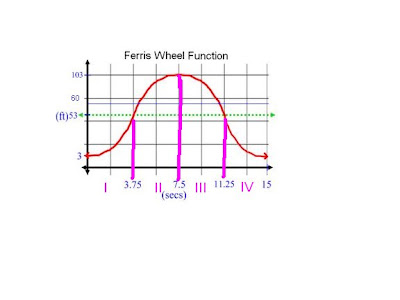
a) sine
a: 50
b: 2π/15
c: 15/4
d: 53
cosine
-50
2π/15
zero
53
50sin[2π/15(x-15/4)] +53
-50cos 2π/15x+53
b) h(x) = 50sin[2π/15(x-15/4)] +53
H(10) = 50sin[2π/15(10-15/40]+53
h = 78 ft.
c) the wheel completes 1 revolution every 15 seconds. The height of the seat on the wheel climbs and reaches its maximum at half the period which is 15s/2. After reaching its max. of 103ft. it starts to decline back down to its min. which is 3. from min to min (trough to trough) is one cycle. therefore it reaches its max at 7.5 seconds.
d) T(x) = 50sin[2π/15(x-15/4)] +53
let θ = [2π/15(x-15/4)]
60 = 50sinθ +53
7 = 50sin θ
7/50 = sin θ
3.0011, 0.1405 = θ
2π/15(x-15/4) = θ
x - 15/4 = 0.1405(15/2π) x = 0.3353 + 15/4 x = 4.0853
2π/15(x-15/4) = = 3.0011
x - 15/4 = 3.0011(15/2π)
x = 7.1646 +15/4
x = 10.9147
10.9147 - 4.0853 = 6.8293s
a person is more than 60 feet in the air for roughly 7 seconds during each revolution.
Diameter of wheel: 100ft.
Seat is 3ft. off ground
Technically max height is actually 100ft. + 3ft. 103ft.
Period: 4/60 ---> 1/15 (1cycle per 15 sec)
a) Write two equations, one sine and one cosine, that would represent the distance above the ground as a function of time. Let t = 0 when the seat is at the lowest point on the wheel.
b) How high will a person be 10 seconds after they begin riding the ferris wheel?
c) How long after a person gets on the ride will they actually be 100 feet in the air?
d) How long, during each revolution, is a person more than 60 feet in the air?thanks group 6, i borrowed your image and i am acknowledging you guys now.

a) sine
a: 50
b: 2π/15
c: 15/4
d: 53
cosine
-50
2π/15
zero
53
50sin[2π/15(x-15/4)] +53
-50cos 2π/15x+53
b) h(x) = 50sin[2π/15(x-15/4)] +53
H(10) = 50sin[2π/15(10-15/40]+53
h = 78 ft.
c) the wheel completes 1 revolution every 15 seconds. The height of the seat on the wheel climbs and reaches its maximum at half the period which is 15s/2. After reaching its max. of 103ft. it starts to decline back down to its min. which is 3. from min to min (trough to trough) is one cycle. therefore it reaches its max at 7.5 seconds.
d) T(x) = 50sin[2π/15(x-15/4)] +53
let θ = [2π/15(x-15/4)]
60 = 50sinθ +53
7 = 50sin θ
7/50 = sin θ
3.0011, 0.1405 = θ
2π/15(x-15/4) = θ
x - 15/4 = 0.1405(15/2π) x = 0.3353 + 15/4 x = 4.0853
2π/15(x-15/4) = = 3.0011
x - 15/4 = 3.0011(15/2π)
x = 7.1646 +15/4
x = 10.9147
10.9147 - 4.0853 = 6.8293s
a person is more than 60 feet in the air for roughly 7 seconds during each revolution.
Sunday, September 23, 2007
circular functions
hi its Anthony. Sorry i started this so late, i was at work for the last few days. Anywho we started off the class doing some warm up graphing questions. later in the class Mr. K started something new. Writing equations for graphs. He started off by showing the relationship between cos(x) and sin(x). Turns out both of these graphs are the same, only difference is the horizontal shift. What i mean by that is:
 cos (x) = sin(x+π/2) and sin(x) = cos(x-π/2)
Now moving on. Graphing graphs from equations is easy but writing equations from graphs was something new to most of us on friday. Remember when writing equations for graphs use DABC. What i mean by DABC is find the verticle shift, amplitude, period, and the horizontal shift. Also Mr. K can never stress enough that i quote " B IS NOT THE PERIOD... B IS NOT NOT NOT NOT NOT THE PEIORD." B helps determin the period. with the following equation:
period = 2π/B
Another new thing we learned was how to graph tan(x).

the dotted lines are the asymptotes (where the graph will never touch). the reason they will never touch is because on the unit circle at those specific points because tan is parallel with the y axis. lastly graphing trig functions should be in your math dictionarys. The next scribe is
Kim-Possible.
Subscribe to:
Posts (Atom)

